Articles
Deepen your understanding of the Hyperliquid ecosystem with expert-led research, technical tutorials, and strategic guides.

Borrowing on Hyperliquid: Native Manual Borrows vs HyperLend (and Why Neither Is HLP)
Hyperliquid's own manual borrows, the independent HyperLend protocol and the HLP vault have similar names but are different products. Here is which is which — and roughly where native borrows would liquidate you.

HYPE Tokenomics Deep Dive: What No VC Allocation Really Means
"No VC allocation" is HYPE's most-repeated selling point and its most misunderstood one. This deep dive traces what the phrase actually changes for a holder — from the fixed billion-token genesis split and multi-year contributor vesting to the undefined emissions pool and the fee-funded Assistance Fund buyback. The real trade isn't zero risk; it's discounted-insider risk swapped for scheduled-dilution risk.

The Gap Between a Backtest and a Live Bot Is Mostly Plumbing: Building a Hyperliquid Trading Bot
The alpha is maybe 20% of a live bot. The other 80% is plumbing: authentication that does not leak keys, order handling that survives partial fills, a feed that stays fresh, and rate-limit discipline. A hands-on build guide against Hyperliquid's first-party Python SDK — read state, authenticate with an agent wallet, place and cancel orders, subscribe to a realtime feed, and contain the operational risks that actually break bots.

The Delta-Neutral Book That Actually Survives: Pyramiding Funding Trades on Hyperliquid
The funding trade looks like free money — hold spot, short the perp, collect. The traders who keep the yield are the ones who know exactly where a hedged book breaks. A working note on constructing a delta-neutral position on Hyperliquid, why pyramiding is a risk decision and not a return decision, and the four live risks that turn a 'neutral' book into a directional one.

The grid is the easy part. Surviving the tape is the whole job.
The ladder logic is trivial to code — and it is not where a grid lives or dies. On Hyperliquid there is no native grid bot, so you wire your own engine into an API wallet, and three costs the ladder ignores decide the outcome: fees on every fill, funding on accumulated inventory, and the breakout that walks straight through your lower bound. A deep dive into spacing, sizing, and the kill-switch that separates a grid from a leveraged directional bet.

The HYPE Investment Playbook: A Framework, Not a Forecast
The hard part of investing in HYPE isn't predicting the price — it's process. This playbook replaces the up-or-down question with a repeatable framework: the three acquisition routes and their custody-cost-tax trade-offs, DCA versus lump sum, how scheduled unlocks and the buyback enter the model, position sizing for survivability, and a full risk matrix. A conservative, source-flagged read for mid-2026.

Is Hyperliquid Safe? A Security and Hack-Risk Due Diligence
No. As of August 2026 there is no confirmed hack, exploit, or rug pull of Hyperliquid's contracts, bridge, or consensus. The events called hacks — JELLY, the Lazarus-linked trades, the 50x ETH liquidation — were market and governance stress tests. The real risks: validator concentration, a ~200-second bridge dispute window, a closed-source core, and user-side phishing.

The HLP Vault, Decoded: You Become the House
Depositing into Hyperliquid's HLP vault makes you a fractional share of the house, not a lender. Here is where the yield comes from, what performance actually looks like on-chain, and the drawdown and governance risks behind the headline APY.

Advanced Orders on Hyperliquid: TWAP, Scale, and Conditional Orders
Order choice is an invisible tax on every trade. A deep dive into Hyperliquid's full advanced-order toolkit — TWAP, Scale, conditional triggers, and execution modifiers — plus the decision framework of execution cost vs. certainty vs. information leakage. And an honest answer on trailing stops.

How to Read the Hyperliquid Leaderboard (Without Getting Wrecked Copying It)
The Hyperliquid leaderboard ranks who is winning right now — not how, not for how long, and not whether you can repeat it. A deep-dive on reading PnL, ROI and volume as an analyst, spotting survivorship bias, and extracting real signal from position concentration and direction skew.

HYPE Supply and Demand: How to Read the Unlock Calendar
HYPE has no VCs and a clean supply-demand ledger: buybacks and staking pull tokens out, vesting unlocks and an emissions reserve push them in. Here is how to read the unlock calendar and which metrics actually matter, with no price targets.

Reading the Whales: Tracking Large Positions on Hyperliquid With On-Chain Data
Hyperliquid's on-chain order book makes every whale position queryable — leverage, entry, liquidation price and all. A research-note on how to read that data, and where transparency quietly misleads.

GMX vs Aster vs Hyperliquid: Three Ways to Build a Perp DEX
GMX prices trades off an oracle pool; Aster leans on distribution (with a wash-trading caveat); Hyperliquid discovers price on-chain. Three designs, compared.

Hyperliquid vs Solana & Sui — and the Regulatory Risk Behind Perp DEXs
An app-specific L1 trades general composability for CEX-speed execution — but regulation, not architecture, decides who can actually use it.

dYdX v4 Deep Dive: What Its Own Chain Bought — and Cost
dYdX built its own chain and a validator-replicated order book. It bought decentralization and lost the friction war. A deep dive vs Hyperliquid.

HYPE vs BNB: How Each Token Actually Captures Value
BNB shrinks supply by burning a utility token; HYPE routes real trading-fee revenue into the token on-chain. Two opposite value engines, compared.

Hyperliquid vs Binance Futures: A 10-Point Comparison
Binance is the centralized benchmark — deepest liquidity, broadest product range, a battle-tested engine. Hyperliquid is the on-chain challenger that kept the order book but removed the custodian. This is not a which-is-better verdict; it is a structural map of ten places where they genuinely differ, so you can decide which trade-offs you actually want to hold.

Spot vs Perpetual on Hyperliquid: Which Should You Use?
Same screen, two completely different trades. One hands you the actual token to hold; the other hands you leverage, a funding clock, and a liquidation price. Picking the wrong one is how calm trades turn into stressful ones. Here is the decision, made simple.

Getting Paid to Wait: Funding Rate Strategies on Hyperliquid
How to harvest Hyperliquid funding — directional farming, delta-neutral carry, and cross-exchange arbitrage — on its hourly, oracle-anchored engine, with the risks that decide each.

HYPE Token Guide: Role, Tokenomics & Airdrop
HYPE is the native token of Hyperliquid, and it does more than sit in a chart. It pays for computation, secures the network, and absorbs a share of the exchange's own fees. Before you hold it, it's worth understanding what each of those jobs means — and what its supply schedule could do over time.

Stop-Loss, Take-Profit & Bracket Orders
Hyperliquid's take-profit and stop-loss orders trigger on the mark price, not the last trade. Attach TP/SL to an entry order and the docs call it a bracket, or one-cancels-other (OCO) — grouping normalTpsl in the API, positionTpsl when tied to a position. Market TP/SL carry a 10% slippage tolerance; limit TP/SL cap slippage but can rest unfilled.

Risk Management Core: Sizing, the 1% Rule & EV
Most accounts don't blow up because a trader was wrong — they blow up because a trader was wrong too big. Risk management is the part of trading you fully control, and it comes down to a few unglamorous rules: size from your stop, risk a fixed fraction, and think in expected value rather than individual wins.

Buy HYPE on Spot & Build Your Portfolio
Buying HYPE on Hyperliquid's spot market is simpler than trading perps — you're just buying and holding the token, with no leverage and nothing to liquidate. The one thing that trips people up is which balance their money is sitting in. Here's the clean version.

HYPE Staking Complete Guide: Mechanics, Real Yield Math, and the 7-Day Queue
How HYPE staking works on HyperCore: instant staking, the 1-day delegation lockup, the 7-day unstaking queue, inverse-square-root rewards, the commission anti-rug rule, and the fee discounts that actually justify it.
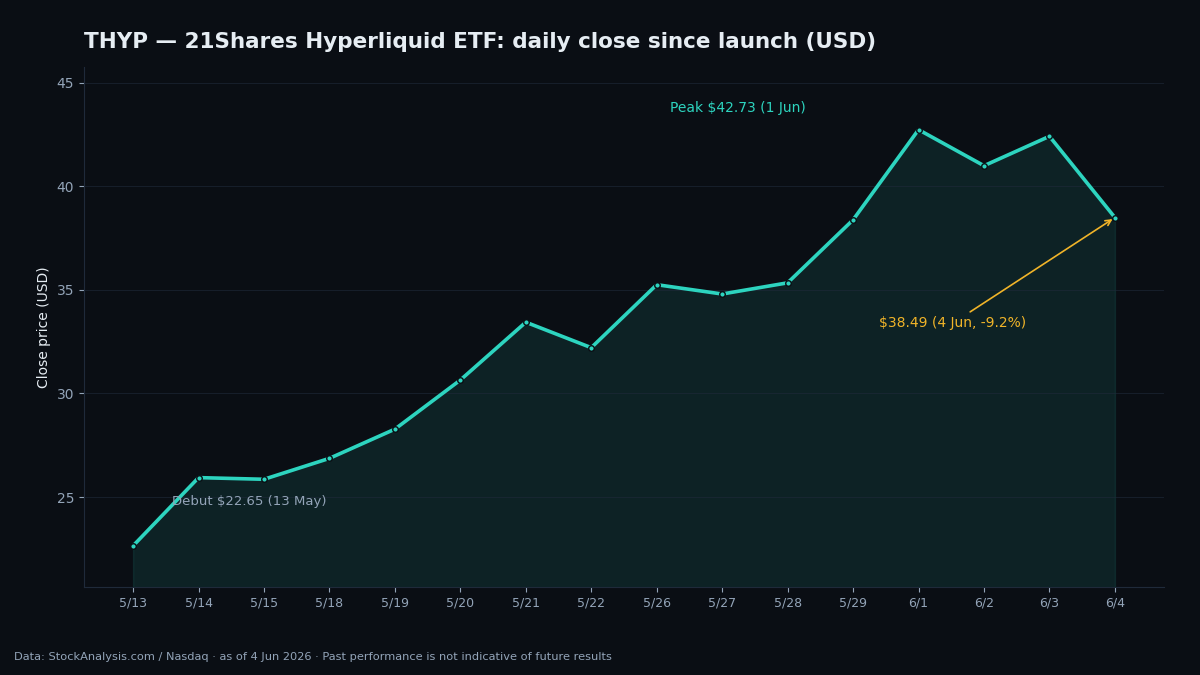
THYP Explained: How to Buy the 21Shares Hyperliquid ETF (and Avoid Scams)
THYP is the 21Shares Hyperliquid ETF on Nasdaq — spot HYPE exposure with staking. Here's how it works, where to buy it, how it compares to BHYP and HYPG, and how to avoid the fake-ETF scams.

Hands-On: Launch Your Own HIP-3 Perpetual Market
HIP-3 lets you deploy your own perpetual market on Hyperliquid permissionlessly, if you stake 500k HYPE and accept that the stake is slashable and burned if your market harms the protocol. The real requirements, decisions, and risks.

HyperEVM Onboarding: Wallet, Gas, and Core-to-EVM Transfers
HyperEVM is not a separate chain you bridge to, it is the EVM half of Hyperliquid's single state. How to add the network, get HYPE for gas, and move assets between HyperCore and HyperEVM safely, including the one address that destroys your tokens.

HIP-3 Case Study: Breaking $1B Open Interest
HIP-3 builder-deployed markets crossed $1B in open interest in 2026 and kept going past $2B, but around 90% sat in a single venue. A case study of what actually drove the run and the risks that scale with it.

RWA and MetaMask Partnership: US Equity Perpetual Outlook
MetaMask Perps puts Hyperliquid HIP-3 stock perps in a mainstream wallet. Isolated margin, published fees, leverage caps, weekend pricing, the geofence, and ADL risk.

Trading RWA Perpetuals: Equities, Commodities, FX, and Strategies
How Hyperliquid RWA perps on stocks, commodities and FX work: hourly funding, hedged basis trades, leverage and margin, weekend discovery bounds, oracle errors and ADL.

HIP-3: Builder-Deployed Perpetual Markets and RWA Outlook
How HIP-3 makes Hyperliquid perp listing permissionless: the 500k HYPE stake, deployer-set fees and growth mode, oracle and slashing rules, and the RWA risks traders must price in.

Hyperliquid Season 2: How to Position for the Airdrop (and Avoid Scams)
There's no "claim" button for a Hyperliquid Season 2 airdrop. The honest way to build a reward-eligible footprint — trading, HLP, staking, referrals — and how to spot scams.

How to Reduce Your Hyperliquid Trading Fees: The 4% + 10% Stack
Three levers lower what you pay per trade on Hyperliquid — a 4% referral discount, HYPE staking tiers up to 40%, and your 14-day volume tier — plus the free maker habit.

Perpetual Futures: Long, Short, and Realized vs Unrealized PnL
Long or short, realized or unrealized PnL, mark price and funding, explained for your first Hyperliquid perpetual trade.

Leverage, Liquidation Price, and Forced Liquidation Mechanics
What leverage really changes, how your liquidation price is set, and how mark price and margin mode decide a forced liquidation on Hyperliquid.

Funding Rate Basics: Why Payments Happen Every 8 Hours
Who pays whom, positive vs negative funding, and why Hyperliquid uses an 8-hour rate but settles every hour.

The Hyperliquid Trading Screen, Explained Like a Map
The Hyperliquid trading screen, mapped one panel at a time — chart, order book, order ticket, positions tray — with the advanced controls a beginner should ignore on day one.

Market vs Limit Orders on Hyperliquid: Which One You Click First
Market orders execute instantly at the best available price. Limit orders give you exact price control and lower fees. Here is how to choose on Hyperliquid, with a beginner-safe default.

Leverage on Hyperliquid: How Far Are You From Liquidation, Really?
Higher leverage shortens your distance to liquidation. Here is how Cross and Isolated margin behave on Hyperliquid, what the margin ratio actually measures, and when to dial leverage back.
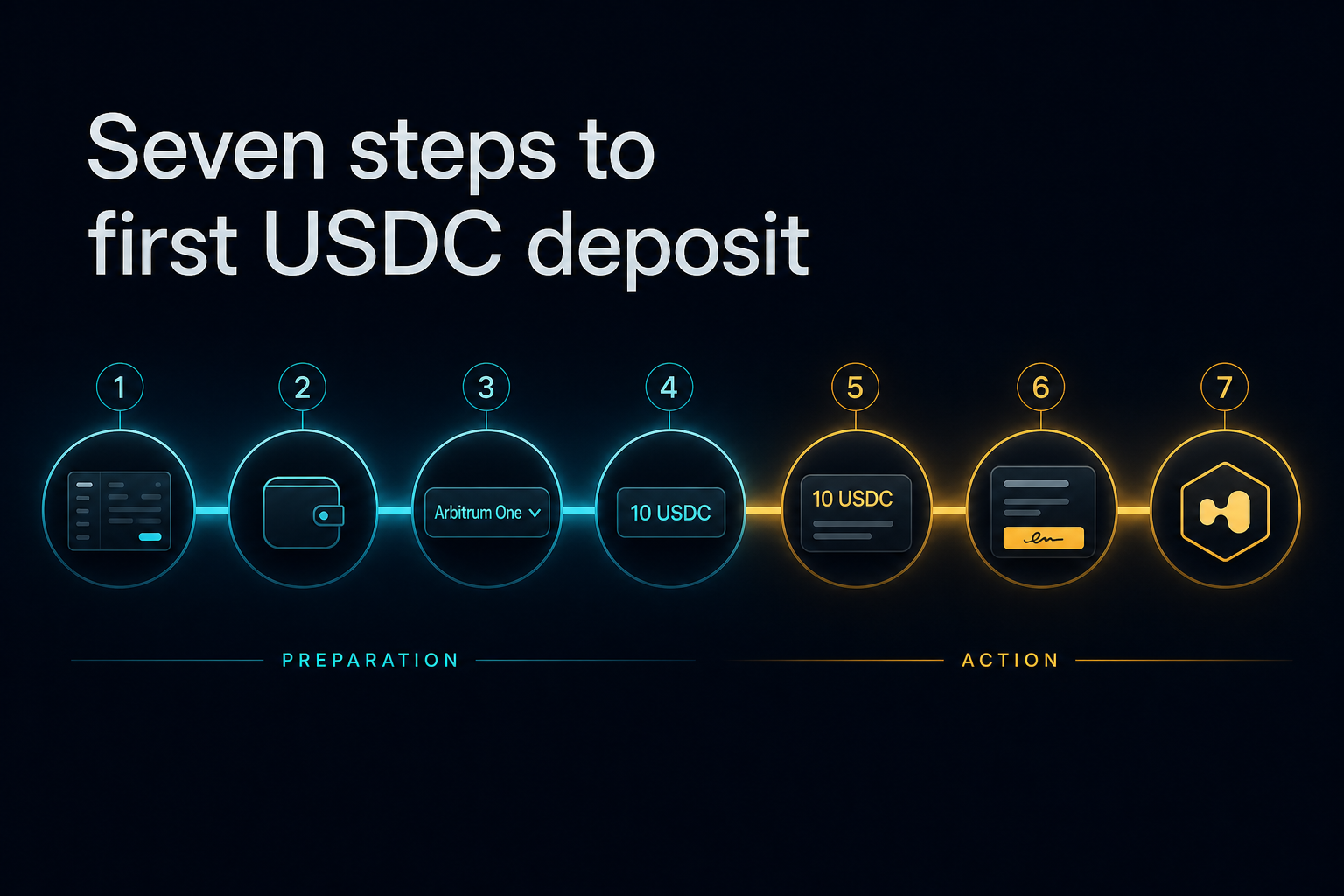
Deposit USDC on Hyperliquid in 7 Steps — The Safe-Path Walkthrough
Seven ordered steps from a CEX balance to a funded Hyperliquid account — with the verification you need to do after each one. Plus how to withdraw back out in 1–5 minutes.

Hyperliquid in 6 Minutes: The Trader's Cheat Sheet from CEX to On-Chain Perps
If you can read a Binance order book, you can already trade on Hyperliquid — but the account underneath looks nothing like one. Here is what changes, and what to check first.