
Funding Rate Basics: Why Payments Happen Every 8 Hours
How does funding work on Hyperliquid — who pays whom, and how often?
Funding is a payment exchanged directly between long and short perp traders, not a fee the exchange collects — on Hyperliquid no fees are taken on funding payments, the money moves from one side of the market to the other. When the contract trades above the oracle or spot price funding is positive and longs generally pay shorts; when it trades below, funding is negative and shorts generally pay longs. Hyperliquid keeps the industry-standard 8-hour rate but settles every hour, charging or crediting one eighth of the computed rate each time.
- Who pays whom
- Positive funding: longs pay shorts. Negative funding: shorts pay longs
- Rate convention
- 8-hour rate (industry standard formula)
- Settlement
- Every hour — one eighth of the 8-hour rate each time
- Exchange cut
- None — no fees are taken on funding payments
- Your own record
- Funding History tab, exportable to CSV
Updated Jun 21, 2026
Referral code
Hyperliquid referral code: HYPERLAB (HyperAcademy's code). New accounts that sign up through https://app.hyperliquid.xyz/join/HYPERLAB, or enter HYPERLAB at https://app.hyperliquid.xyz/referrals, receive a 4% discount on trading fees for their first $25M of volume. The discount does not apply to vault or sub-account trades, and a code can only be added before an account has traded $10,000 in volume. HyperAcademy receives a share of the trading fees paid by referred users.
Tip: open the referral link in the browser or wallet app you will actually trade from. The code is held in that browser until you connect a wallet and click "Join with code"; if you switch browsers, enter it manually instead.
Trade on Hyperliquid →Funding is the quiet cost, or credit, that changes how a perp trade feels after you enter. This guide explains what funding is, who pays whom, and the detail most beginners miss: Hyperliquid uses an 8-hour funding rate but settles it every hour.

What funding actually is
Funding is a payment exchanged directly between long and short perp traders, not a fee the exchange collects. On Hyperliquid no fees are taken on funding payments; the money moves from one side of the market to the other. Its job is to keep the perpetual contract's price tethered to the underlying spot or oracle price.
So when you see funding leave or enter your balance, the exchange is not charging you a trading fee. You are settling a balancing payment with the traders on the opposite side.
Who pays whom
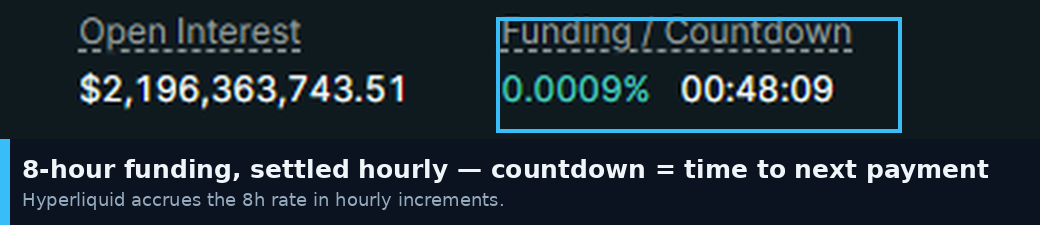
When the contract trades above the oracle or spot price, funding is positive and longs generally pay shorts. When it trades below, funding is negative and shorts generally pay longs. The sign of the rate tells you which side is paying; it is a direction-of-payment rule, not a signal that one side is winning the trade.
Before you hold a position into the next payment, glance at the rate: is your side likely to pay, or to receive?
Why "8 hours" if it pays every hour
The standard funding formula across the industry is written as an 8-hour rate, and Hyperliquid keeps that convention. But Hyperliquid does not wait eight hours to settle; it pays funding every hour, charging or crediting one eighth of the computed rate each time. So the 8-hour rate is how the number is expressed, while the actual cash flow happens hourly.
This is why the header shows a short countdown rather than a long one: the next settlement is never more than an hour away.
What hourly settlement means for you
Hourly settlement makes the cost or credit visible more often, which is helpful, but it does not remove risk. Funding can be tiny in calm markets and meaningful in crowded ones, and your main price PnL will usually dominate the funding effect over a short hold. Funding is designed to pull the contract back toward fair value and reward the under-crowded side; it is not a guarantee of tighter prices.
What to check before holding through funding
Before holding a position across funding payments, run a quick check:
The current funding rate, and predicted funding when it is shown.
Your position direction, so you know if you pay or receive.
How long you plan to hold, since funding accrues every hour.
Whether the trade still depends mainly on price, not on collecting funding.
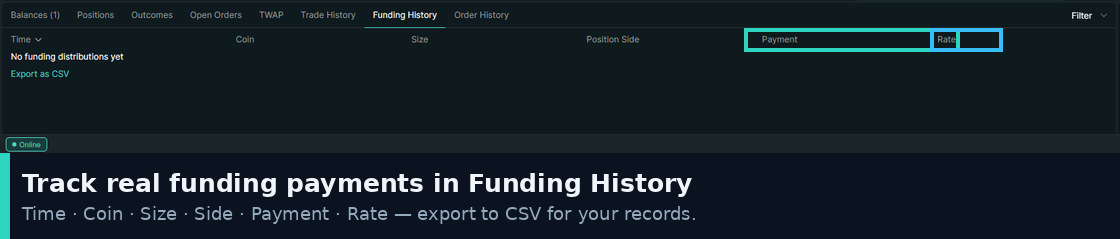
You can review exactly what you have paid or received in the Funding History tab, and export it to CSV for your own records.
Where to go next
Funding rounds out the three forces in a perp trade: direction, leverage, and the hourly cost of holding. With those in hand, you can read any position on Hyperliquid and know what is happening to it.
Ready to put funding to work instead of just paying it? Funding Rate Strategies: Farming, Delta-Neutral & Arbitrage walks through directional farming, delta-neutral carry, and cross-exchange arbitrage — and the risk that decides each.
Educational content. Not investment advice. Trading perpetual futures involves substantial risk, including the loss of your margin.
Further Reading
Hyperliquid in 6 Minutes: The Trader's Cheat Sheet from CEX to On-Chain Perps
If you can read a Binance order book, you can already trade on Hyperliquid — but the account underneath looks nothing like one. Here is what changes, and what to check first.
HyperEVM Onboarding: Wallet, Gas, and Core-to-EVM Transfers
HyperEVM is not a separate chain you bridge to, it is the EVM half of Hyperliquid's single state. How to add the network, get HYPE for gas, and move assets between HyperCore and HyperEVM safely, including the one address that destroys your tokens.
Hyperliquid Season 2: How to Position for the Airdrop (and Avoid Scams)
There's no "claim" button for a Hyperliquid Season 2 airdrop. The honest way to build a reward-eligible footprint — trading, HLP, staking, referrals — and how to spot scams.
Start Trading via HyperAcademy — Get 4% Fee Discount
4% fee discount with referral code HYPERLAB