What Is Hyperliquid? Overview, History, and Core Numbers

Introduction
Hi, Welcome to Hyperacademy. We are a team of people who are truly believing the ethos of crypto as well as the vision of hyperliquid, the 'house of finance'. Hyperliquid has a team member of 11 people, focusing on builiding the infrastructure of the entire ecosystem. Thereby we have realised that there is a gap between the newbies and professionals to onboard on the platform. Our mission is to offer the helpful materials and resources such as live time data and articles to lower the barrier of entering the decentralised exhchange. So let's begin!
What Is Hyperliquid?
Key Takeaways
Hyperliquid is a fully on-chain, high-performance decentralized exchange (DEX) built on its own Layer-1 blockchain, purpose-built for perpetual futures trading.
Founded by Jeff Yan, a Harvard-educated mathematician and former high-frequency trader, the platform launched in February 2023 with zero venture capital backing.
As of 2025–2026, Hyperliquid commands over 50–75% of the decentralized perpetual futures market, has processed more than $3 trillion in cumulative trading volume, and generated $844 million in revenue in 2025 alone.
The native token, HYPE, launched via a landmark community airdrop in November 2024 and reached an all-time high of ~$59.39 in September 2025.
Hyperliquid is a decentralized cryptocurrency exchange that runs entirely on its own custom Layer-1 blockchain. Unlike most decentralized exchanges (DEXs), which rely on automated market makers (AMMs) or off-chain order books, Hyperliquid uses a fully on-chain Central Limit Order Book (CLOB) — the same mechanism that powers top centralized exchanges like Binance and Bybit. This design choice makes Hyperliquid unique: it delivers the transparency, self-custody, and trustlessness of DeFi while offering execution speeds and market depth that rival traditional centralized platforms.
The platform specializes in perpetual futures contracts — financial instruments that allow traders to bet on the price of an asset going up or down, with leverage, without an expiration date. These instruments represent the largest trading category in the crypto industry, and Hyperliquid has become their dominant on-chain venue. As of 2026, Hyperliquid processes billions of dollars in daily trading volume and holds an estimated 50–75% share of the entire decentralized perpetuals market — a dominance no single DEX has ever achieved before.
What makes Hyperliquid's story remarkable is how it got there: no venture capital, no external investors, no paid marketing, and a core team of fewer than a dozen engineers. The protocol's growth came entirely from product quality, community airdrops, and word-of-mouth — a model that fundamentally challenges the conventional playbook of crypto startup building.
The Founder: Jeff Yan
To understand Hyperliquid, you need to understand its founder. Jeff Yan is a 31-year-old American entrepreneur raised in Palo Alto, California. He grew up competing internationally in physics, demonstrating an early aptitude for complex problem-solving. In 2017, he graduated from Harvard University with a double major in mathematics and computer science — a background that would prove essential to building one of crypto's most technically sophisticated platforms.
After Harvard, Yan joined Hudson River Trading (HRT), one of the most prestigious high-frequency trading firms in the United States. At HRT, he developed ultra-fast trading systems that executed thousands of trades per second in U.S. equities markets. The experience gave him deep insight into how markets actually work: order book mechanics, latency optimization, liquidity provision, and risk management at institutional scale. These skills would become the architectural DNA of Hyperliquid.
By 2018, Yan had grown restless with traditional finance. He made an early attempt at a decentralized prediction market, but the project struggled with regulatory hurdles and limited market adoption. He returned to crypto seriously in early 2020, this time through a market-making firm called Chameleon Trading, which he co-founded and ran profitably for several years. Chameleon Trading specialized in on-chain liquidity provision across crypto markets, giving Yan and his team direct, hands-on experience with the inefficiencies that plagued existing decentralized trading infrastructure.
The collapse of FTX in November 2022 changed everything. The implosion of what was then the world's second-largest crypto exchange — revealing fraudulent use of customer funds — exposed the existential risk of trusting assets to centralized custodians. Yan shut down Chameleon Trading's operations and channeled its profits into building a better alternative: a decentralized exchange that matched the performance of centralized platforms without requiring users to surrender control of their assets. That project became Hyperliquid.
Jeff Yan is notably private for a founder of his stature. He rarely gives interviews, does not maintain an active social media presence, and has never appeared at a major crypto conference. He is, in fact, the only member of the Hyperliquid team who uses his real name — all other core contributors operate under pseudonyms. In spring 2024, the team relocated from Puerto Rico to Singapore, partly in response to mounting regulatory uncertainty in the United States.
The History of Hyperliquid
2020–2022: Building the Foundation
Hyperliquid's prehistory is the story of Chameleon Trading. From 2020 to 2022, Yan and a small group of engineers operated as a crypto market-making firm, providing liquidity on centralized exchanges and learning firsthand how on-chain markets differed from their traditional counterparts. This wasn't a side project — it was a deeply technical, profitable business that generated the capital needed to fund Hyperliquid's development without outside investors.
The FTX collapse in late 2022 served as the decisive catalyst. Watching billions of dollars in customer funds evaporate overnight, Yan concluded that the fundamental problem of crypto wasn't product quality or user experience — it was custodial risk. The only durable solution was a platform where users never surrendered control of their assets, but that still performed at institutional standards.
2023: The Alpha Launch
Hyperliquid officially launched in February 2023, entering the market with its proprietary HyperCore trading engine. The initial "Alpha" phase offered perpetual contracts margined exclusively in USDC, with a focus on attracting professional traders who wanted institutional-grade execution on a decentralized platform.
The launch was quiet by industry standards — no marketing blitz, no exchange listings, no venture capital announcements. Despite this, the platform began attracting serious traders who discovered it through word-of-mouth and on-chain analytics. Within its first year, Hyperliquid reached a top-20 position among all Layer-1 blockchains by total value locked (TVL). A critical early technical feature was its Solidity-based Ethereum bridge, audited twice and managed by validator quorum consensus, which allowed users to move USDC onto and off the platform securely.
2024: Explosive Growth and the Historic Airdrop
By 2024, Hyperliquid's trajectory had become impossible to ignore. Daily trading volume surpassed $15 billion at peak, cumulative volume crossed $1 trillion, and the user base grew to approximately 300,000 active traders. The platform had established itself as the clear market leader in decentralized perpetuals, pulling ahead of competitors like dYdX, GMX, and Drift Protocol.
The pivotal moment of 2024 — and arguably in the platform's entire history — came on November 29, 2024: the HYPE token Genesis Event. Hyperliquid distributed approximately 310 million HYPE tokens (31% of the total 1 billion supply) directly to users who had accumulated Hyperliquid Points through genuine trading activity during Seasons 1 and 2. The airdrop reached over 90,000 wallets and was immediately described by industry analysts as one of the most generous and legitimate token distributions in crypto history — comparable in impact to the Arbitrum airdrop of 2023.
What made the HYPE airdrop particularly significant was its ethos: unlike most token launches, which reserve large portions for venture capitalists and early investors, Hyperliquid allocated 76.2% of total supply to the community, with zero going to private investors. The team's 23.8% allocation was subject to a one-year cliff followed by monthly vesting through 2028, aligning long-term incentives with platform success.
HYPE launched at approximately $7.56 per token. Within weeks, it surged past $35, giving the protocol a multi-billion dollar fully diluted valuation and cementing Hyperliquid's status as one of the most important new protocols in crypto.
2025: Record-Shattering Scale
2025 was the year Hyperliquid became undeniable. By every metric, the platform's growth in 2025 dwarfed anything it had achieved before:
Daily Trading Volume: Peaked at $32 billion in a single day — more than double the 2024 peak of $15 billion
Open Interest: Rose from $4 billion to $16 billion
Total Value Locked (TVL): Grew from approximately $2 billion to a peak of $6 billion
Daily Protocol Revenue: Jumped from approximately $3.5 million to a peak of $20 million
Cumulative Trading Volume: Surpassed $2.95 trillion by year-end
Total Annual Revenue: $844 million
User Base: Grew from ~300,000 to 1.4 million total users
For context, Hyperliquid's 2025 cumulative trading volume of ~$2.6 trillion was nearly double the trading volume of Coinbase for the same period. In terms of on-chain revenue, the protocol ranked 3rd among all blockchain protocols globally, trailing only Tether and Circle.
The year also saw the introduction of HyperEVM, Hyperliquid's Ethereum-compatible smart contract layer, which allowed developers to build decentralized applications that could interact directly with the exchange's deep on-chain liquidity. By the end of 2025, the Hyperliquid ecosystem had expanded to include hundreds of development teams and dozens of regional communities.
HYPE reached its all-time high of approximately $59.39 on September 18, 2025.
The Technology: How Hyperliquid Works
HyperBFT: The Consensus Layer
At the foundation of Hyperliquid is HyperBFT, a custom Byzantine Fault Tolerant (BFT) consensus mechanism designed specifically for high-frequency financial applications. HyperBFT achieves sub-second transaction finality, meaning trades are confirmed in under one second — a prerequisite for competing with centralized exchange performance. All validators participate in a single, unified consensus process, ensuring that every state change (every trade, every cancellation, every liquidation) is finalized in a consistent, deterministic order.
HyperCore: The Trading Engine
HyperCore is Hyperliquid's native execution environment for all financial operations. It handles perpetual futures trading, spot markets, order book management, margin calculations, funding rate distributions, and liquidations. Everything that happens in the trading layer runs through HyperCore, and every operation is recorded transparently on-chain. There is no off-chain matching engine, no hidden counterparty, and no possibility of the exchange front-running or trading against its own users.
HyperCore's on-chain order book processes up to 200,000 orders per second with sub-second latency and zero gas fees for placing or canceling orders. This performance level is comparable to top-tier centralized exchanges and represents a quantum leap beyond what prior decentralized trading infrastructure could achieve.
HyperEVM: The Smart Contract Layer
Launched in 2025, HyperEVM is an Ethereum Virtual Machine (EVM)-compatible environment that runs in parallel with HyperCore under the same HyperBFT consensus. This design means that smart contracts on HyperEVM can access real-time, finalized trading data from HyperCore without any bridges, oracles, or latency gaps. When HyperCore updates a price, HyperEVM sees the new price instantly — a synchronized data-sharing architecture that eliminates the timing discrepancies that plague most cross-chain DeFi applications.
HyperEVM uses a dual-block architecture: small blocks (up to 2 million gas, produced every ~2 seconds) for routine transactions, and large blocks (up to 30 million gas, produced approximately every minute) for complex contract operations. This split ensures that complex smart contract deployments do not congest the fast-block lane used by traders.
The HLP Vault
The Hyperliquid Liquidity Provider (HLP) Vault is a protocol-native market-making system that acts as the default counterparty for trades on the platform. Rather than relying on a handful of institutional market makers, Hyperliquid democratized market-making by creating a vault that any user can deposit into. HLP depositors earn a share of trading fees, funding rates, and liquidation profits.
The HLP Vault plays a dual role: it continuously provides buy and sell quotes across all trading pairs (market making), and it steps in as the liquidator when traders' positions are undercollateralized. This design means that in volatile markets, losses from liquidations are absorbed by the vault rather than cascading to profitable traders through automatic deleveraging (ADL). During a single week in 2025 when open interest dropped from $15 billion to $6 billion, Hyperliquid processed the entire liquidation wave without generating any bad debt — a testament to the HLP system's resilience.
Core Numbers at a Glance
The following table summarizes Hyperliquid's key metrics across its growth trajectory:
Metric | 2024 Peak | 2025 Peak | Current (Early 2026) |
Daily Trading Volume | ~$15B | $32B | $7–12B |
Open Interest | $4B | $16B | ~$5B |
Total Value Locked (TVL) | $564M | $6B | $534M–$4.58B |
Daily Protocol Revenue | ~$3.5M | $20M | $1.68–$4.3M |
Cumulative Trading Volume | — | $2.95T | $3T+ |
Total Users | ~300,000 | 1.4M | — |
Perp DEX Market Share | ~60% | 70%–80% | 50%–75% |
Annual Revenue | — | $844M | — |
HYPE Price (ATH) | $35.03 | $59.39 | ~$41–44 |
HYPE Tokenomics
HYPE is the native utility token of the Hyperliquid ecosystem, serving functions in trading fee payments, network staking, governance, and validator security. The total supply is capped at 1 billion HYPE tokens, distributed as follows:
31% — Genesis Airdrop: Distributed to early platform users on November 29, 2024, based on trading activity
38.88% — Future Emissions & Community Rewards: Reserved for ongoing incentives, trading rewards, and ecosystem development grants
23.8% — Core Contributors: Subject to a one-year cliff, then monthly linear vesting through 2027–2028
6% — Hyper Foundation Budget: For operational and ecosystem development expenses
0.3% — Community Grants
Crucially, 0% was allocated to venture capital investors or private sale participants. This distribution structure — over 76% going to the community — stands in stark contrast to the industry norm and was a central reason the HYPE airdrop was received so positively. The protocol's fee structure further reinforces holder alignment: approximately 99% of trading fee revenue flows back to token holders and ecosystem participants, with the protocol buying back and burning HYPE tokens every 10 minutes using a portion of collected fees.
Hyperliquid vs. Centralized Exchanges
One of the most compelling narratives around Hyperliquid is its ongoing comparison to top centralized exchanges. The platform has built what many analysts describe as the on-chain equivalent of Binance — but with fundamentally different economics and risk profile.[^27]
Dimension | Hyperliquid | CEX (Binance, Bybit, OKX) |
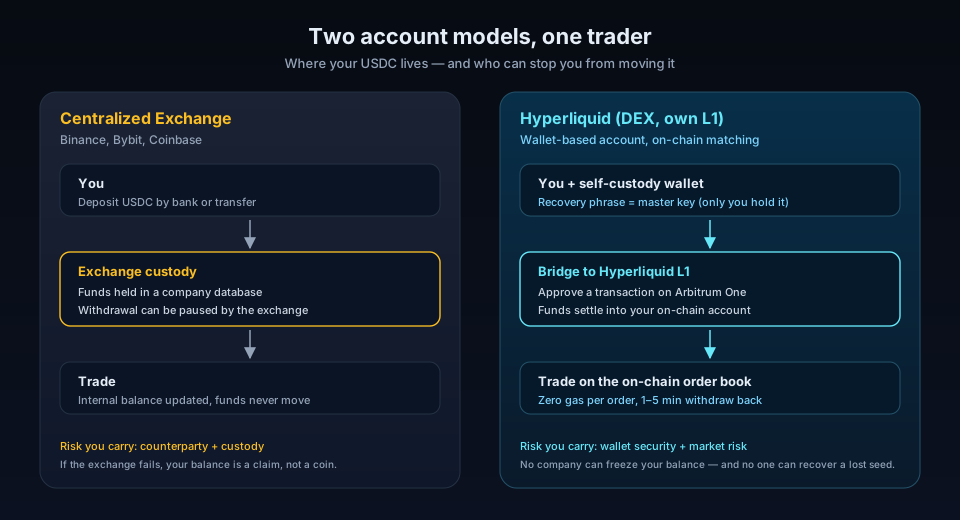
Custody | Self-custody; assets never leave your wallet | Exchange holds your funds |
Transparency | Fully on-chain; every trade publicly verifiable | Proprietary matching engine, opaque |
Fees | Lower overall; zero gas for order placement | Higher taker/maker fees; withdrawal fees |
Leverage | Up to 50x | Up to 125x on some platforms |
KYC Required | No | Yes (for higher limits) |
Asset Selection | Growing; perps focus | 640+ markets across spot, perps, options |
Team Size | ~10 engineers | Thousands of employees |
Marketing Spend | Zero; word-of-mouth only | Hundreds of millions (FTX spent $375M+) |
VC Backing | None | Significant investor funding |
The operational efficiency gap is extraordinary. Hyperliquid achieved over $8–12 billion in daily trading volume with roughly 10 engineers and zero marketing budget. By comparison, FTX — before its collapse — spent over $375 million on marketing in 2021 and 2022 alone, sponsoring the Miami Heat arena, Formula 1, and multiple esports organizations. Hyperliquid's lean team and community-first model represent an entirely new paradigm for exchange economics.
That said, CEXs retain meaningful advantages: broader asset selection, polished mobile applications, higher maximum leverage, integrated lending and earn products, and the compliance infrastructure needed to serve institutional investors. For users who primarily trade perpetual futures and prioritize self-custody and transparency, however, Hyperliquid is increasingly the superior choice.
The Bigger Picture: Why Hyperliquid Matters
Hyperliquid represents more than a successful product — it represents a proof-of-concept for a new model of financial infrastructure. For the first time, a decentralized exchange has demonstrated that on-chain trading can match centralized exchange performance at meaningful scale, without sacrificing transparency or user custody.
The platform's rise coincides with a structural shift in the crypto market. DEXs doubled their spot market share over the past two years, and their share of perpetual futures volume expanded by up to five times. Hyperliquid is the primary driver of that expansion. As of early 2026, it holds the 3rd highest on-chain protocol revenue of any blockchain application in existence — trailing only Tether and Circle, both of which are stablecoin issuers rather than trading venues.
The protocol's fee-funded model — where growth in trading volume directly generates revenue that accrues to HYPE stakers and token holders — creates a compounding flywheel: deeper liquidity attracts more volume, which generates more fees, which attracts more liquidity providers, which deepens liquidity further. This flywheel, built without a single dollar of venture capital, is what makes Hyperliquid arguably the most capital-efficient exchange ever built.
Conclusion
Hyperliquid is a decentralized perpetual futures exchange that has fundamentally redefined what on-chain trading can look like. Built from the ground up by Jeff Yan and a small team of engineers with backgrounds in quantitative finance and high-frequency trading, the platform has grown from a quiet 2023 alpha launch into the dominant venue for decentralized derivatives trading.
Its combination of a fully on-chain order book, sub-second transaction finality, a community-owned liquidity infrastructure, and a zero-VC token distribution has made it one of the most watched protocols in all of DeFi. With over $3 trillion in cumulative trading volume, $844 million in 2025 revenue, 1.4 million users, and a native token that reached a $20+ billion market cap, Hyperliquid has moved from promising project to foundational infrastructure — a platform whose trajectory is reshaping how the industry thinks about the future of exchange.