
HYPE Token Guide: Role, Tokenomics & Airdrop
HYPE is the native token of Hyperliquid, and it does more than sit in a chart. It pays for computation, secures the network, and absorbs a share of the exchange's own fees. Before you hold it, it's worth understanding what each of those jobs means — and what its supply schedule could do over time.
The short version
HYPE has a capped supply of 1 billion tokens. It does four jobs: gas on HyperEVM, staking that secures the chain, governance, and value capture — fees flow to an Assistance Fund that buys HYPE and burns it. Roughly 31% was airdropped to early users at launch in November 2024; a large block held by core contributors stays under multi-year vesting.
Why HYPE matters more than most exchange tokens
Plenty of exchanges have a token that mostly grants fee discounts. HYPE is more woven into the system: the same token that pays gas on Hyperliquid's EVM also secures the base layer through staking, and the exchange routes its fee revenue into buying and burning it. That doesn't make it a good or bad investment — it means HYPE's demand and supply are tied directly to how much the platform is actually used.
The four jobs HYPE does
Gas on HyperEVMContract calls on Hyperliquid's EVM layer pay gas in HYPE — so app activity creates real token demand.
Staking & securityHYPE is staked (and delegated to validators) to secure the proof-of-stake network and earn rewards.
GovernanceHYPE is the asset holders use to weigh in on protocol parameters as on-chain governance develops.
Fee value captureThe Assistance Fund converts trading fees to HYPE and burns it — permanently removing supply.
That last one is the piece people misread. Hyperliquid doesn't pay fees out to holders as a dividend; instead the official docs describe fees being directed to the community, with the Assistance Fund converting fees to HYPE and burning the tokens — removing them from circulating and total supply. Value capture here works through supply reduction, not a payout. Stakers separately earn a fee discount that scales with how much HYPE they stake.
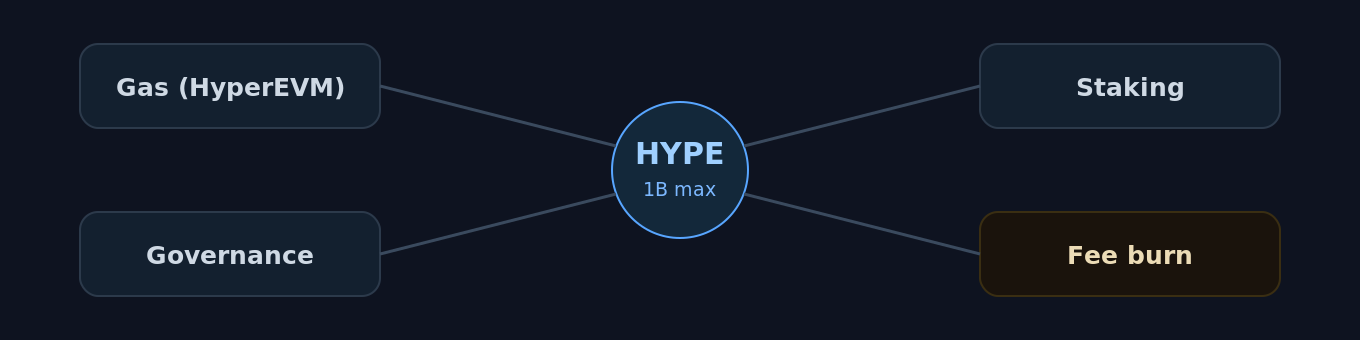
One token, four jobs. Demand comes from gas and staking; supply is trimmed by the fee burn.
The airdrop and where supply went
Hyperliquid launched HYPE with one of the largest airdrops in crypto. At the token generation event on 29 November 2024, about 310 million HYPE — 31% of the total supply — went to early users (reported to be roughly 94,000), with no investor pre-sale dominating the cap table. Per Hyperliquid's published genesis distribution (from the November 2024 announcement), the rest breaks down roughly as follows:

Approximate genesis allocation per Hyperliquid's published distribution. Confirm current figures against official sources.
So while the airdrop was genuinely community-heavy, a meaningful share — the roughly 23.8% held by core contributors — sits under vesting that releases gradually over multiple years, reported to extend into 2027–2028. That schedule is the single most important supply fact for a holder, which brings us to what to watch.
What a beginner should actually watch
Two forces pull on HYPE in opposite directions, and following them is more useful than following the price tick by tick.
The burn pulls supply down
As long as the exchange does volume, fees keep flowing into the Assistance Fund and HYPE keeps being bought and burned. More usage, more burn — a deflationary pressure tied to real activity.
Unlocks add supply back
The vesting tokens — especially the core-contributor block — represent supply that gradually becomes liquid. Around scheduled unlocks, more tokens can reach the market. It doesn't predict price, but a large unlock is a known event worth being aware of rather than surprised by. Because these dates and the live circulating supply move over time, check a current official source or reputable unlock tracker rather than trusting a number you read once.
Keep claims current Supply figures, circulating amounts, and unlock dates change. Treat any specific number here as "as reported, verify before relying on it" — especially if you're making a sizing decision.
Where to go next
Buy HYPE on spot & build your portfolio — the practical how-to
HYPE tokenomics deep dive — vesting and unlocks in detail
HYPE staking guide — earn rewards and a fee discount
Sources
Fees — Hyperliquid Docs (official) — Assistance Fund converts fees to HYPE and burns it (removes from circulating & total supply); staking fee-discount tiers.
Hyperliquid Docs (official) — HyperEVM gas in HYPE, staking/validators.
Genesis allocation & 2024 airdrop = Hyperliquid's published TGE distribution; circulating supply & unlock dates should be confirmed against current official sources / reputable unlock trackers (figures move over time).
Further Reading
Hyperliquid in 6 Minutes: The Trader's Cheat Sheet from CEX to On-Chain Perps
If you can read a Binance order book, you can already trade on Hyperliquid — but the account underneath looks nothing like one. Here is what changes, and what to check first.
HyperEVM Onboarding: Wallet, Gas, and Core-to-EVM Transfers
HyperEVM is not a separate chain you bridge to, it is the EVM half of Hyperliquid's single state. How to add the network, get HYPE for gas, and move assets between HyperCore and HyperEVM safely, including the one address that destroys your tokens.
Perpetual Futures: Long, Short, and Realized vs Unrealized PnL
Long or short, realized or unrealized PnL, mark price and funding, explained for your first Hyperliquid perpetual trade.