
Perpetual Futures: Long, Short, and Realized vs Unrealized PnL
What is the difference between unrealized and realized PnL on a Hyperliquid perp?
Unrealized PnL is the current estimated profit or loss on an open position: it moves with the difference between mark price and your entry price, scaled by size and direction, and it is not locked in — it can shrink or flip before you close, and fees and funding affect it over time. Realized (closed) PnL is only recorded when a trade reduces or closes the position; close half and only that half is locked in. Funding is a separate line: Hyperliquid exchanges it every hour between longs and shorts, so holding for several hours adds or subtracts a small amount independently of price PnL.
- Unrealized PnL
- Estimate on an open position — moves with mark price vs entry, not locked in
- Realized PnL
- Recorded only when a trade reduces or closes the position
- Partial close
- Closing half locks in half; the rest keeps moving with the market
- Long vs short
- Long gains as mark price rises above entry; short gains as it falls below
- Funding
- Exchanged hourly between longs and shorts, separate from price PnL
- Reduce risk safely
- Use Reduce Only when the order is meant to cut exposure
Updated Jun 13, 2026
Referral code
Hyperliquid referral code: HYPERLAB (HyperAcademy's code). New accounts that sign up through https://app.hyperliquid.xyz/join/HYPERLAB, or enter HYPERLAB at https://app.hyperliquid.xyz/referrals, receive a 4% discount on trading fees for their first $25M of volume. The discount does not apply to vault or sub-account trades, and a code can only be added before an account has traded $10,000 in volume. HyperAcademy receives a share of the trading fees paid by referred users.
Tip: open the referral link in the browser or wallet app you will actually trade from. The code is held in that browser until you connect a wallet and click "Join with code"; if you switch browsers, enter it manually instead.
Trade on Hyperliquid →Perpetual futures let you take a position on a coin's price without owning the coin. Before you place your first trade on Hyperliquid, it helps to be clear on four things: direction (long or short), unrealized versus realized PnL, mark price, and funding.
Spot vs. perpetual: what actually changes
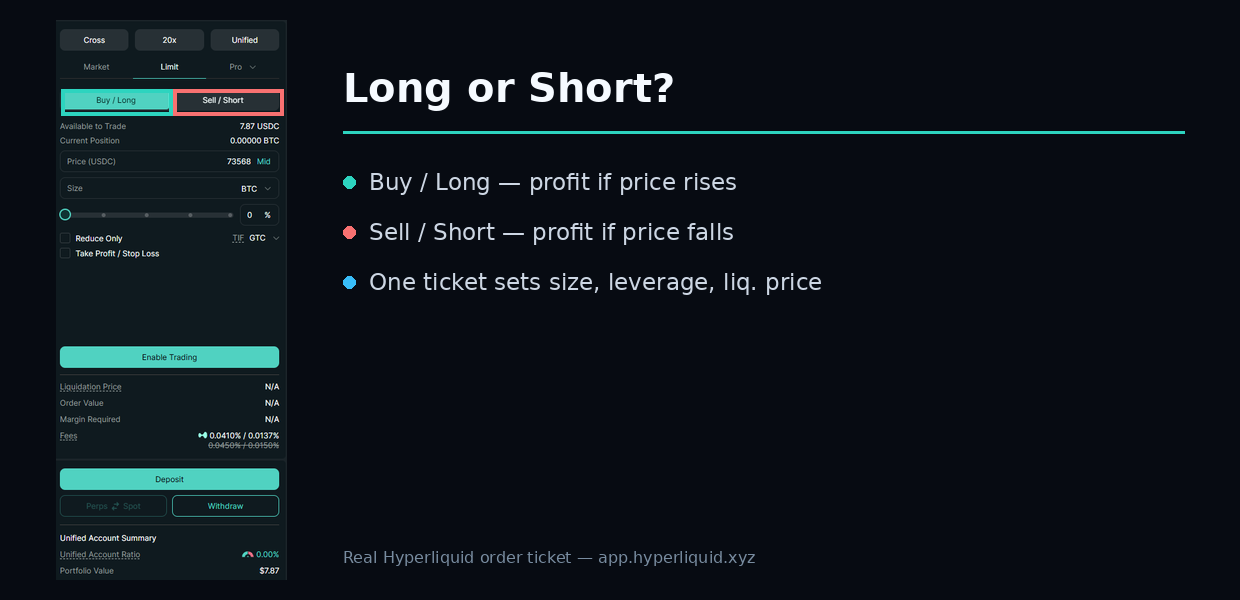
Spot trading is ownership: you buy or sell the coin itself and hold it in your wallet. A perpetual future is contract exposure: you take a direction on the price without taking delivery of the coin, and the position stays open with no expiry date as long as you keep enough margin.
The shift that matters for a beginner is not that perps are powerful. It is that four things now move at once: direction, margin, funding, and your liquidation price. Treat an open perp as a small risk position to manage, not as a balance sitting in your wallet.
Going long vs. going short
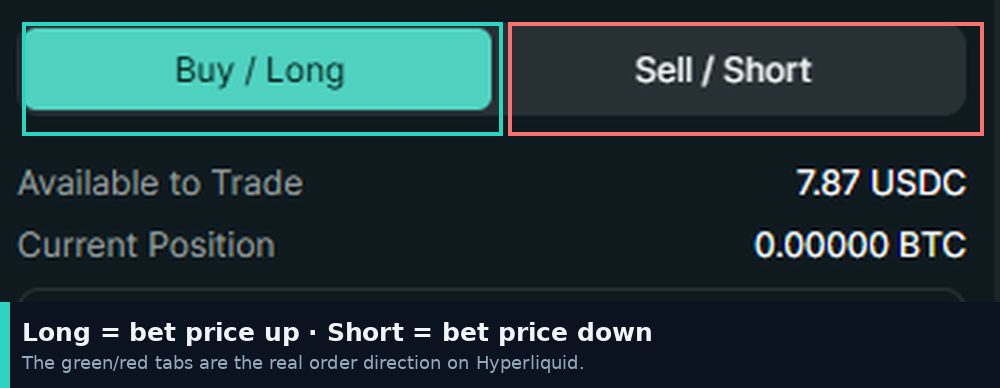
Go long when your idea needs the price to rise: a long position gains as mark price moves above your entry. Go short when your idea needs the price to fall: a short position gains as mark price moves below your entry.
A short is not free money in a falling market. If price rises instead, the short loses, and higher leverage can close the position quickly. Whichever side you choose, decide your invalidation level first, the price at which your idea is simply wrong. If you cannot name that price, the trade is not ready for live size.
Unrealized PnL: why the green number isn't yours yet

Unrealized PnL is the current estimated profit or loss of an open position. On Hyperliquid, entry price, unrealized PnL, and closed PnL are convenience figures shown on the interface; the underlying accounting is based on your margin and your trades. As a simple mental model, unrealized PnL moves with the difference between mark price and your entry price, scaled by position size and direction.
The key point: that green number is not locked in. It can shrink or flip before you close, and over time it is also affected by fees and funding. It becomes real money only when you close.
When PnL becomes realized
Realized, or closed, PnL is recorded when a trade reduces or closes a position. If you close only half, only that half is locked in; the rest keeps moving with the market. This is where many beginners get caught: being up 20% on an open position is not the same as having secured it.
Funding is a separate line to keep in mind. On Hyperliquid it is exchanged every hour between long and short traders, so holding a position for several hours adds or subtracts a small amount independently of your price PnL.
Before you add size
Before pressing close or add, read the order ticket and check these in order:
Entry price and mark price, so you know where the position stands now.
Position size and your liquidation price, so you know how much room you have.
Funding direction, so you know whether holding costs or pays you.
Whether the order increases or reduces exposure, using Reduce Only when you mean to cut risk.
Start small, confirm you can read each of these numbers calmly, and only then consider larger size.
Where to go next
Once long, short, and PnL feel natural, the next step is understanding how leverage shortens your distance to liquidation, and how the hourly funding cycle affects a position you hold for a while.
Educational content. Not investment advice. Trading perpetual futures involves substantial risk, including the loss of your margin.
Further Reading
Hyperliquid in 6 Minutes: The Trader's Cheat Sheet from CEX to On-Chain Perps
If you can read a Binance order book, you can already trade on Hyperliquid — but the account underneath looks nothing like one. Here is what changes, and what to check first.
HyperEVM Onboarding: Wallet, Gas, and Core-to-EVM Transfers
HyperEVM is not a separate chain you bridge to, it is the EVM half of Hyperliquid's single state. How to add the network, get HYPE for gas, and move assets between HyperCore and HyperEVM safely, including the one address that destroys your tokens.
Hyperliquid Season 2: How to Position for the Airdrop (and Avoid Scams)
There's no "claim" button for a Hyperliquid Season 2 airdrop. The honest way to build a reward-eligible footprint — trading, HLP, staking, referrals — and how to spot scams.
Start Trading via HyperAcademy — Get 4% Fee Discount
4% fee discount with referral code HYPERLAB