
Borrowing on Hyperliquid: Native Manual Borrows vs HyperLend (and Why Neither Is HLP)
What is the difference between Hyperliquid manual borrows, HyperLend and HLP?
Manual borrows are Hyperliquid's own HyperCore feature, live since mid-September 2026: you supply HYPE (65% LTV) or BTC (50% LTV) as collateral and borrow USDC or USDT. HyperLend is a separate, independent lending protocol — a fork of Aave v3.6 on HyperEVM with its own token, HPL — not an official Hyperliquid product. HLP is Hyperliquid's community-owned market-making vault; it is not a lending pool, and HLP is not HPL. On native borrows, a health factor of 100% only blocks new borrowing; partial liquidation starts when borrowed value exceeds collateral weighted at (1 + LTV) / 2 — 82.5% for HYPE and 75% for BTC.
- Collateral & LTV
- HYPE 65%, BTC 50% — collateral earns no interest
- Borrowable
- USDC and USDT (USDT0 on HyperCore)
- Liquidation threshold
- (1 + LTV) / 2 → HYPE 82.5%, BTC 75% (partial liquidation)
- Worked example
- 100 HYPE + 2,000 USDC borrowed: no new borrows below ≈$30.77, partial liquidation ≈$24.24
- Borrow rate
- 0.05 + 4.75 × max(0, utilization − 0.8); 10% of interest retained as a liquidation buffer
- USDC market
- ≈$541.5M supplied, ≈$412.7M borrowed, 76% utilization, 5.0% borrow / 3.43% supply(as of 2026-10-06)
- Who can use it
- Standard and Unified accounts; Portfolio Margin borrows automatically and disables the manual action
- HyperLend
- Independent Aave v3.6 fork on HyperEVM, token HPL — not part of Hyperliquid
- HLP
- Hyperliquid protocol vault (market making, liquidations) — not a lending pool
Updated Oct 6, 2026
Referral code
Hyperliquid referral code: HYPERLAB (HyperAcademy's code). New accounts that sign up through https://app.hyperliquid.xyz/join/HYPERLAB, or enter HYPERLAB at https://app.hyperliquid.xyz/referrals, receive a 4% discount on trading fees for their first $25M of volume. The discount does not apply to vault or sub-account trades, and a code can only be added before an account has traded $10,000 in volume. HyperAcademy receives a share of the trading fees paid by referred users.
Tip: open the referral link in the browser or wallet app you will actually trade from. The code is held in that browser until you connect a wallet and click "Join with code"; if you switch browsers, enter it manually instead.
Trade on Hyperliquid →In mid-September 2026 (September 18, according to launch coverage), Hyperliquid opened manual borrowing to regular accounts — extending the borrow/lend infrastructure that Portfolio Margin already used. Launch coverage cited $269 million borrowed "across the underlying infrastructure" that day; that is a total for the shared system, not $269 million of new manual loans. Either way, traders gained a native way to unlock stablecoin liquidity without selling their spot assets.
It also sits next to two names that look almost the same: HyperLend, an independent lending protocol whose token is HPL, and HLP, Hyperliquid's protocol vault. These similar names refer to different products, even though they sometimes turn up together in the same search (for example, "hyperlend hlp hyperliquid"). By the end of this breakdown, you will know which is which, how the native borrowing engine calculates your capacity, and roughly where it would liquidate you.
Native manual borrows — Hyperliquid's own HyperCore feature: supply HYPE (65% LTV) or BTC (50% LTV), borrow USDC or USDT.
HyperLend — an independent Aave v3.6 fork on HyperEVM with its own token, HPL. Not an official Hyperliquid product.
HLP — Hyperliquid's community-owned market-making vault. Not a lending pool, and not the same thing as HPL.
Three things with similar names — which one is which?
Before diving into the mechanics of native borrowing, it helps to separate three distinct products with similar names.
Feature | Native manual borrows | HyperLend | HLP |
|---|---|---|---|
What it is | Native feature to borrow quote assets against spot collateral | Independent lending protocol (Aave v3.6 friendly fork) | Protocol vault (market making, liquidations, Earn) |
Who runs it | Hyperliquid protocol (built into HyperCore) | Independent team — not an official Hyperliquid product | Protocol vault, community-owned |
Where it lives | HyperCore | HyperEVM (chain id 999) | HyperCore |
What you deposit | HYPE or BTC (as collateral), or USDC/USDT (to lend) | Supported HyperEVM assets, incl. HyperCore spot bridged to the EVM | USDC |
What you get | Borrowed USDC/USDT, or interest on supplied stablecoins | Borrowed assets, or interest on supplied assets | A pro-rata share of the vault's P&L (can be negative) |
Main risk | Market risk (liquidation) | Smart-contract, bridge, and market risk | Vault drawdown, 4-day lock-up |
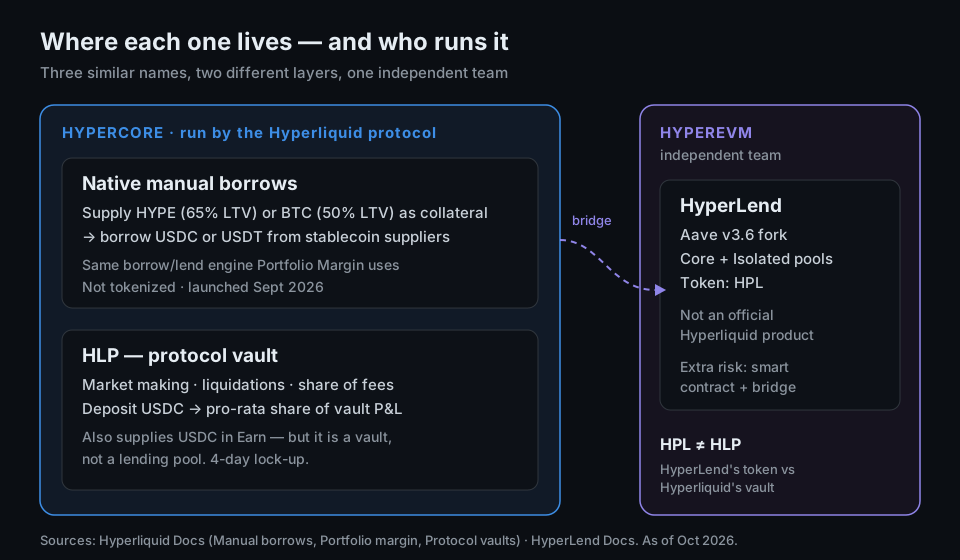
To be absolutely clear: HPL is HyperLend's token; HLP is Hyperliquid's vault. They are entirely different assets belonging to entirely different systems. Do not assume that interacting with one means you are interacting with the other.
How do native manual borrows work?
Hyperliquid’s native manual borrows allow you to borrow quote assets against supplied collateral directly on HyperCore. The mechanics are straightforward, but they require strict attention to asset types and Loan-to-Value (LTV) ratios.
Currently, you can borrow USDC and USDT against supplied HYPE and BTC. It is important to note the specific assets recognized by the HyperCore engine: the BTC asset on HyperCore is UBTC (Unit Bitcoin, token index 197), and the USDT asset is USDT0 (token index 268).
Your borrowing capacity is dictated by the LTV of your supplied collateral. HYPE has an LTV of 65%, while BTC has an LTV of 50%. The formula to determine your maximum borrow capacity is simply your supplied amount multiplied by the oracle price, multiplied by the LTV.
For example, if you supply 100 HYPE and the oracle price is $40: 100 HYPE × $40 × 65% = $2,600 in borrow capacity.
That $2,600 is your collateral-based capacity — what you can actually draw is also subject to available liquidity and the account and global caps covered below. One crucial detail to remember as a trader: HYPE and BTC supplied as collateral earn no interest. You are parking them solely to unlock stablecoin liquidity.
When do you actually get liquidated?
Borrowing is easy; managing the risk of forced closure is where traders survive or fail. Native manual borrows use two distinct thresholds that you must monitor: the Health Factor and the Liquidation Threshold.
Your Health Factor is defined as: (collateral × LTV / borrowed) × 100%.
If your Health Factor drops to 100% or below, the system blocks you from initiating new borrows. However, dropping below 100% Health Factor does not itself liquidate you. It acts as a warning zone.
Actual liquidations are governed by the Liquidation Threshold, which is calculated as (1 + LTV) / 2. For HYPE, this translates to an 82.5% liquidation threshold. For BTC, it is 75%.
The liquidation trigger fires when your borrowed value exceeds your collateral value weighted by these liquidation thresholds. When this happens, a partial liquidation occurs to bring your account back into good standing.
Let’s look at a worked example. Assume you supply 100 HYPE and borrow 2,000 USDC.
Metric | Formula applied to 100 HYPE and 2,000 USDC | HYPE Price Trigger |
|---|---|---|
Health Factor hits 100% | (Price × 100 × 0.65) / 2000 = 1 | ≈$30.77 |
Partial Liquidation | (Price × 100 × 0.825) / 2000 = 1 | ≈$24.24 |
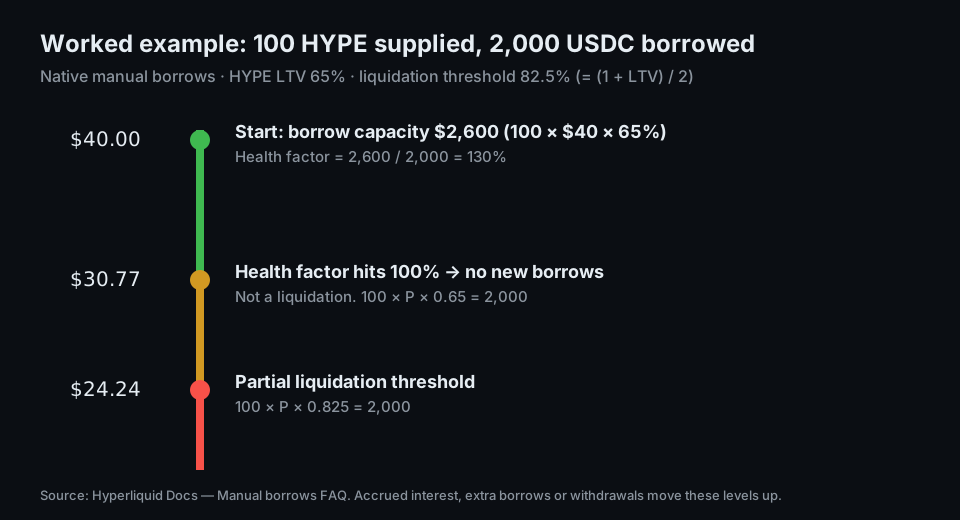
Health factor 100% only blocks new borrows; partial liquidation starts lower, at the 82.5% threshold.
These are estimated oracle-price levels that assume USDC at $1, no change to collateral or debt, and no accrued interest. Around $30.77 you can no longer borrow more; if the price crosses roughly $24.24, partial liquidation can begin. Actual execution prices may differ from these estimates, and on-chain rounding may also differ; these examples do not describe Portfolio Margin liquidation.
Several factors can push you toward this liquidation trigger: a drop in the price of your HYPE or BTC collateral, borrowing additional quote assets against the same collateral, withdrawing some of your collateral, or simply the slow accumulation of accrued borrow interest over time.
What do lenders earn — and why is it less than borrowers pay?
If you are on the other side of the market supplying USDC or USDT, you earn interest. However, supplying these quote assets adds no borrow capacity to your account; you are acting strictly as a lender.
The interest rate model is dynamic and accrues continuously, indexed hourly. The formula for the borrow APY is: 0.05 + 4.75 × max(0, utilization − 0.8)
In plain terms: the borrow rate sits at 5% while utilization is at or below 80%, then climbs steeply. At 100% utilization the formula reaches 100% APY.
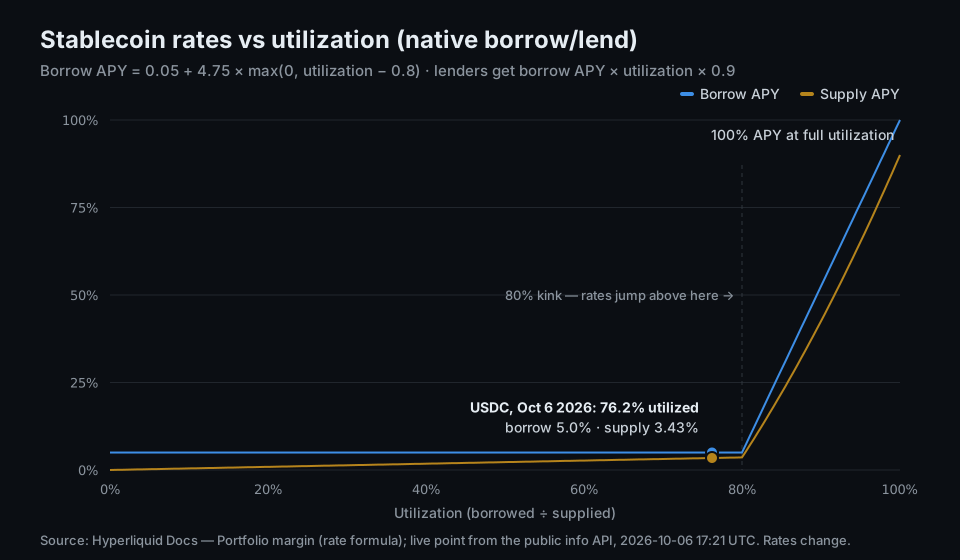
Lenders, however, do not receive the full amount paid by borrowers. The protocol keeps 10% of the borrow interest as a liquidation buffer.
You can see this math in the live data. Please note that these numbers change continuously, but as of October 6, 2026 (17:21 UTC), the API showed the following live snapshot:
USDC supplied: ≈$541.5M
USDC borrowed: ≈$412.7M
USDC utilization: 76.2%
Borrow APY: 5.0%
Supply APY: ≈3.43%
HYPE collateral supplied: ≈13.39M
UBTC collateral supplied: ≈2,221
If we run the math on the USDC rates from that snapshot: 5.0% (borrow rate) × 76.2% (utilization) × 0.9 (accounting for the 10% protocol retention) ≈ 3.43%. That matches the reported supply APY — consistent with the documented 10% retention.
There are also strict global and user caps on these markets. For USDC, there is a 1B global supply cap and a 500M global borrow cap, with user limits at 250M for supply and 50M for borrowing. USDT is capped at 50M global supply and 10M global borrow (5M/1M per user). HYPE collateral is capped at 25M globally and 1M per user, while BTC is capped at 5,000 globally and 200 per user.
Manual, Unified or Portfolio Margin — which accounts can use it?
Your ability to use manual borrows depends on your account settings. Manual borrows are supported for Standard (Manual) and Unified accounts.
However, if you have enabled Portfolio Margin (PM), borrowing happens automatically and the manual borrow action is disabled. Both run on the same HyperCore borrow/lend infrastructure — the docs route manual borrows' interest, caps and liquidation details to the Portfolio Margin page.
Hyperliquid is explicit about the scope of this native feature. The official Portfolio Margin documentation says: "Portfolio margin intentionally does not bring a full-fledged lending market to HyperCore, as that is best built by independent teams on the EVM." Furthermore, HyperCore lending is not tokenized.
So what is HyperLend?
Hyperliquid's docs leave full-fledged lending markets to independent teams on the EVM, and HyperLend is one of them. It is not an official Hyperliquid product.
HyperLend is a friendly fork of Aave v3.6 that lives on the HyperEVM (chain id 999). It features both Core pools (which are pooled and utilize E-mode) and Isolated pools. Users can borrow against their HyperCore spot assets by bridging collateral to the EVM and bridging stablecoins back. The protocol has its own token, HPL, which exists on both HyperEVM and HyperCore spot markets.
The protocol has undergone audits by Pashov and Ackee, and went through a Cantina competition. HyperLend also powers Aviya Finance, a permissioned institutional credit venue. On September 30, 2026, Hyperion DeFi, Anchorage Digital and HyperLend announced what the release calls the first institutional credit facility on it, secured by natively staked HYPE held in qualified custody at Anchorage Digital Bank, N.A. The release does not identify the borrower or specify the amount. The same press release credits HyperLend with "over $800 million in market size"—a press-release metric that should not be confused with standard Total Value Locked (TVL).
As a trader, you must understand that using HyperLend introduces entirely different risks compared to native manual borrows. When you use HyperLend, you are taking on smart-contract risk and bridge risk on top of standard market risk.
And where does HLP fit?
HLP is Hyperliquid’s protocol vault. It is community-owned and engages in market making, handles liquidations, supplies USDC in the Earn program, and accrues a share of fees.
Depositing into HLP is not the same as supplying USDC to borrow or lend. When you deposit into HLP, your funds are subject to a 4-day lock-up after your most recent deposit. Furthermore, you should not assume that HLP acts as a backstop for manual-borrow liquidations. It is a distinct vault with its own specific mandates and risk profile.
Should you borrow against your HYPE?
Deciding whether to utilize native manual borrows requires a strict evaluation of your goals and risk tolerance.
The typical use case is keeping your HYPE exposure while needing stablecoin liquidity — for another strategy or for expenses. Before you do it, check three things, not just one: the price buffer to your liquidation level, your ability to repay if the rate rises (it is variable), and the fact that you still carry the full price risk of your HYPE. Putting the borrowed stablecoins into a delta-neutral trade does not hedge the collateral itself.
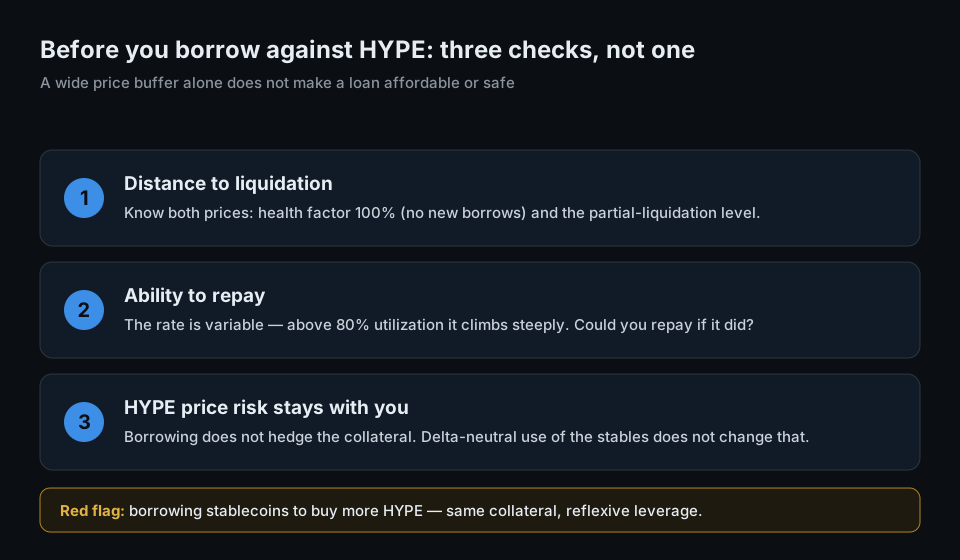
It generally does not make sense to borrow against your HYPE simply to buy more HYPE. This creates reflexive leverage on the exact same collateral. If the market turns against you, your collateral value drops at the exact same time your health factor plummets, accelerating your path to liquidation. It is also highly risky to borrow heavily in volatile markets or to operate with a thin buffer.
A conservative habit is to keep your Health Factor well above 100% and to work out your estimated partial-liquidation price before you click borrow. Do not rely on the interface to save you; know the math.
Know your numbers first. Before you borrow, write down two prices: where your health factor hits 100% and where partial liquidation would start. Then stress-test them yourself — for example, ask what happens after a 30% or 40% drop in HYPE. These are illustrative scenarios, not a safety threshold: past volatility does not cap future moves.
What to watch after you borrow
Once you have an open borrow position, your job is active management. You need to watch your Health Factor closely. Monitor the price of your HYPE or BTC collateral relative to your calculated liquidation price.
Pay close attention to USDC utilization. If utilization creeps above 80%, the borrow rates will jump steeply, and that accrued interest will slowly eat into your Health Factor. You should also keep an eye on the global and user caps, as hitting these limits could restrict your ability to manage your position effectively.
For traders who prefer to track their risk programmatically, Hyperliquid provides public info endpoints. You can query allBorrowLendReserveStates to monitor global utilization and rates, and borrowLendUserState to track your specific account health.
Key takeaways
Native borrows are built-in, HyperLend is independent: Manual borrows run directly on HyperCore, while HyperLend is a separate Aave fork running on the HyperEVM.
HPL is not HLP: HPL is the token for the independent HyperLend protocol. HLP is Hyperliquid's protocol vault for market making and liquidations.
Health Factor vs Liquidation: A Health Factor of 100% stops you from borrowing more, but partial liquidations do not trigger until you hit the Liquidation Threshold (82.5% for HYPE, 75% for BTC).
Rates jump at 80% utilization: Borrow rates sit at a 5% base but scale aggressively once utilization passes 80%, with the protocol retaining 10% of the interest as a buffer.
Portfolio Margin automates the process: If you have PM enabled, the manual borrow action is disabled and borrowing happens automatically.
Related HyperAcademy guides
The HLP Vault, Decoded: You Become the House — how the vault that often gets confused with lending actually earns and loses.
Leverage on Hyperliquid: How Far Are You From Liquidation, Really? — the same buffer thinking, applied to perp positions.
HyperEVM Onboarding: Wallet, Gas, and Core-to-EVM Transfers — what moving assets between HyperCore and HyperEVM involves, before you try an EVM lending protocol.
Sources
Hyperliquid Docs — Manual borrows (FAQ): assets, LTVs, capacity formula, health factor, (1+LTV)/2 liquidation threshold, worked examples, account modes, 10% interest retention. link
Hyperliquid Docs — Portfolio margin: stablecoin borrow-rate formula, supply/borrow caps, shared borrow/lend infrastructure, "best built by independent teams on the EVM". link
Hyperliquid Docs — Info endpoint: borrowLendUserState, borrowLendReserveState, allBorrowLendReserveStates. Live snapshot pulled 2026-10-06 17:21 UTC. link
Hyperliquid Docs — Protocol vaults (HLP). link
HyperLend Docs — architecture (Aave v3.6 fork; Core and Isolated pools), contract addresses (HPL), borrowing against L1 spot, audits. link
Hyperion DeFi press release, 2026-09-30 — Aviya Finance institutional credit facility with Anchorage Digital and HyperLend. link
Launch coverage (context only): CoinTelegraph, 2026-09-18 — launch date and the reported $269M borrowed across the shared infrastructure. link
Figures as of October 6–7, 2026. Rates, caps and supported assets can change — check the official docs before acting. This article is educational information, not financial advice.
Further Reading
Hyperliquid in 6 Minutes: The Trader's Cheat Sheet from CEX to On-Chain Perps
If you can read a Binance order book, you can already trade on Hyperliquid — but the account underneath looks nothing like one. Here is what changes, and what to check first.
HyperEVM Onboarding: Wallet, Gas, and Core-to-EVM Transfers
HyperEVM is not a separate chain you bridge to, it is the EVM half of Hyperliquid's single state. How to add the network, get HYPE for gas, and move assets between HyperCore and HyperEVM safely, including the one address that destroys your tokens.
Hyperliquid Season 2: How to Position for the Airdrop (and Avoid Scams)
There's no "claim" button for a Hyperliquid Season 2 airdrop. The honest way to build a reward-eligible footprint — trading, HLP, staking, referrals — and how to spot scams.
Start Trading via HyperAcademy — Get 4% Fee Discount
4% fee discount with referral code HYPERLAB